
Custom Jewelry Manufacturing Costs: What Moves Them
Cost conversations go wrong when they start with a number instead of a driver. Five things move a jewelry quote: the base metal, the plating stack, the stone and chain selections, the packaging format and the quantity against the published minimums of 50, 100 and 100+ pieces per design. The schedule matters too, because 3D CAD takes under 48 hours while sampling runs 25–30 days.

Key takeaways
- Base material sets the floor: stainless steel, artisan eco-brass and 925 silver at 100+ per design.
- Finish options are vacuum PVD plating for steel, rhodium, gold at 14K, 18K and 24K and an anti-tarnish e-coat on silver and brass.
- Stones, chains and findings, hallmarks and packaging are the four optional customisation fields that add work.
- Schedule cost is small at the front: CAD is under 48 hours, while sampling at 25–30 days is where the real time sits.
Five drivers, in the order they move a quote
The first is metal. Silver, brass and stainless steel each carry a different minimum because each takes a different route through casting, machining and finishing, and the minimum is the point at which that route becomes worth setting up. The second is the coating: multi-layer electroplating in 14K, 18K or 24K gold or rhodium for silver and brass, with a protective anti-tarnish e-coating on top, or PVD vacuum plating for stainless steel.
The third driver is what sits on the surface: natural stones, freshwater pearls, chains and findings. The fourth is the identity work, where laser engraving, logos and purity hallmarks such as the S925 hallmark, an 18KGP mark on plated work and 316L for stainless steel add a manufacturing pass. The fifth is packaging, from foil-stamped gift boxes, logo tags, display backing cards, barcode labelling and velvet or microfiber pouches.
The route an order takes also shifts where the work starts. On an OEM/ODM project where the buyer supplies the CAD file, the process opens with tooling and the buyer owns the design. Where the design is developed with the factory, the work opens with concept and modelling, and the six customer-facing stages are inquiry, consultation, CAD and prototype, sample and approval, bulk production, and the final QC that precedes delivery. Same bench, different starting point, and the starting point determines which cost lines are live in month one.
A minimum is also a useful sanity check on a design. If a supplier proposes a quantity far above the published minimum for the material, either the piece needs more tooling than the brief implies, or the quote has been padded, and both are worth a question before a sample is ordered. The published minimums are the reference point that makes the question easy to ask.
Where the schedule and the cost diverge
Time and cost are not the same lever. Redrawing a CAD model is cheap in materials and quick in hours; changing a casting mould after sampling is neither. That is why the front of the process absorbs revisions so easily and the middle of it does not.
| Driver | Published options | Why it moves cost |
|---|---|---|
| Base material | 925 sterling silver, brass, stainless steel | Sets the minimum and the finishing route |
| Plating and coating | 14K / 18K / 24K gold, rhodium, anti-tarnish e-coating, PVD | Adds a deposition pass and quality control at the end |
| Stones and chains | Natural stones, freshwater pearls, chains and findings | Setting labour and component sourcing |
| Hallmarks and engraving | S925, 316L, 18KGP, laser engraving | Extra precision pass per piece |
| Packaging | Gift boxes, pouches, backing cards, barcode labels | Handling and assembly after inspection |
Why minimums exist at all
A minimum order quantity is the quantity at which tooling and a plating batch stop being disproportionate. Silver sits at 50 pieces per design because casting is quick and the finish is short. Brass sits at 100 because a base metal only becomes a saleable product once the plating stack and the anti-tarnish layer are applied. Stainless steel sits at 100+ because it is machined and vacuum-plated.
Read in that light, the minimum is not a hurdle, it is the smaller of two numbers: the quantity the factory needs to run the process and the quantity you need to test a design in the market. When those two numbers are close, a first order is comfortable; when they are far apart, the design is probably wrong for the material.
The CAD stage is the cheap part, and that is the point
Design work is quoted at under 48 hours and costs screen time. Sampling is quoted at 25–30 days and costs bench time across wax printing, mould casting, stone setting, polishing and electroplating. Production is quoted at 3–4 weeks and repeats those bench operations at volume.
Spending an extra day at the CAD stage to close a design question is therefore the best-value day in the whole schedule. The same question raised after the sample has been cast is answered in the sampling window, which is measured in weeks rather than hours.
Everything quoted on this page is published in the open at https://www.tttjewelry.com/, including the minimums, the plating menu and the packaging formats, so a buyer can check each driver directly instead of waiting for a quotation to explain it. A quote that maps onto those six published fields is also comparable with any other quote built the same way, which is how two suppliers can be judged on the same list rather than on two different summaries.
Worked example: CAD as a slice of the sampling window
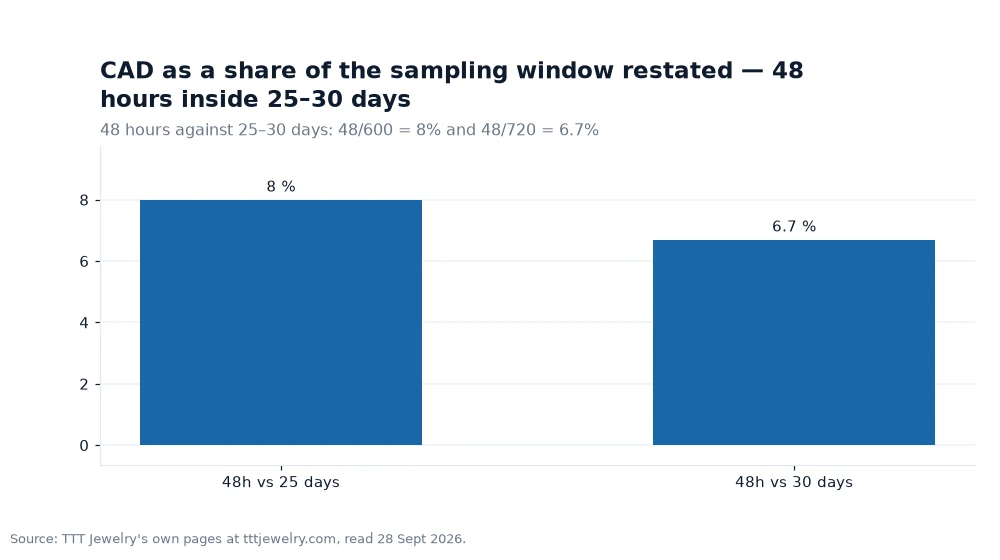
Compare the two front-end stages in hours, using 24 hours a day. CAD is under 48 hours, so take 48. Sampling is 25–30 days: 25 × 24 = 600 hours at the fast end and 30 × 24 = 720 hours at the slow end.
Divide CAD by each: 48 ÷ 600 = 0.08, which is 8%. And 48 ÷ 720 = 0.0666, which rounds to 6.7%. So the design stage is between 6.7% and 8% of the sampling window in calendar terms, or roughly one day in twelve. That is why design changes are the least expensive revisions available, and why the published figures put CAD first in the sequence rather than alongside the bench work. The 48-hour and 25–30 day figures are the manufacturer's; the percentages are mine.
Frequently asked questions
Which material keeps a first order smallest?
artisan brass with recycled content, 316L stainless steel and 925 silver.
What can be added to a piece without changing the metal?
Plating and finishes, stones and accents, chains and findings, hallmarks and engraving, and packaging, which together make up the six customisation fields the factory publishes.
Does a cheaper plating option change the quality check?
No. Whatever the coating, final quality control sits after electroplating and before packing, and the published claim is a 100% inspection of the order.
Asking about drivers instead of prices
A supplier who can name the drivers of a quote is telling you how the order will be built, which is more useful than any single figure. Work through the six customisation fields in order, match the metal to the design, and let the quantities follow from the published minimums. The plating and hallmark choices are grouped under factory capabilities, and the base-metal behaviour is spelled out for brass jewelry where the coating carries the finish.
The published detail behind this piece — the eight-stage factory route, then the six customisation options as well as the 14K / 18K / 24K gold and rhodium plating list — sits on the maker's own pages via tttjewelry.com, which I checked on 28 Sept 2026. All of it is published by TTT Jewelry on tttjewelry.com. The day-and-week bookkeeping is mine rather than the manufacturer's [1]